Tuesday, January 22, 2013

TORRES DEL PAINE, JAN. 21st


SOUTHERN CHILE-  Perito Moreno Glacier and Torres del Paine   Jan. 16th-17th

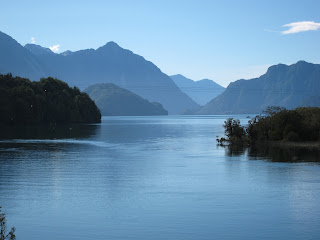
Sitting at 10:30 pm looking across a still reflective lake at the famous Torres del Paine I am aware of the quietness, the late night light, the quiet chatter around a distant campfire.
This is a lovely spot…and for free. Most everything is very expensive here ( we just had a beer here for $5.00, 3 day park fee is $38.00.(One hour drive through is also $38.00) Gas is about $7.00 a gallon) We are isolated, everything is brought in . Lettuce and tomatoes from northern Chile. Tropical fruits from who knows where.
We’ve been hanging out in our special spot on Lago Azul for three days. Naps, walks in the hills above the lake, dinnertime at dusk (11pm). A real pleasure and a much needed respite from continuous travel. Tomorrow we head toward Puerto Natales and further down toward the island of Tierra del Fuego.

Our campsite on little used Lago Azul. We spent 3 nights and days just gazing at the lake and mountains.

Another view of the Torres.

The remnants of an old dock on the lake. Only manmade evidence of former times. No lights other than the stars.

As I rode out of the park the views from different locations change the perspective. It is quite a place!

I am tired. I’d like not to be packing up every day or two. I feel psychically drained and need to re-invigorate myself with doing nothing or staying in a nice place and just going for walks. I am close to Ushuaia which in most people’s minds is the end of the road. Most motorcyclists return from Ushuaia to Buenos Aires and ship their bikes back home-be it to Europe or the States. Since I still have a good half years my intention is to turn northward from Ushuaia and visit a friend on his large Estancia and settle in for some serious cowboy (gaucho) time riding the range, eating lamb over an open fire, drinking maté and learning a bit about gaucho lore. It is very strong here, and very much alive, unlike American cowboy lore which has faded with history.
This is Chalten, half a days drive further north from Torres del Peine. The picture above and below are from Perito Moreno and Glaciers National Park.
You can get quite close and when the calving starts it is a shaking experience. These ice pieces are 150 feet tall.

Mountains everywhere as you skim down the spine of the Andes

Everything here has a tilt. Not just the jagged peaks but the buildings. I can't tell if it is because of the strong winds that come off of the southern Pacific oceans intermingling with the 1000's of Islands or passing over the Andes and descending onto the plains. It seems built into the architecture. Some would call it sloppy workmanship. Others would say they are doing the best they can with limited and expensive supplies, in either case the mark of early immigrants can bee seen everywhere. The Welsh, Croat and northern Europeans who came here slightly over 100 years ago left an indelible mark.Evidence of even earlier settlements extend back 10,000 years.
 Nature rules though. The roads remain unpaved except in towns and travel is slowed by strong side winds.

Monday, January 21, 2013

TIME PASSES-even when you're having fun and without internet connection

 A roadside site of adoration of "Gaucho Gil"a farmworker in the 1870's who fell in love with a wealthy widow and when her brother's found out about the affair, tried to kill him. He "escaped" into the army and fought against the Paraguayans then returned to be captured, tortured and upon his final breath swore that the killers son would die if he killed Gaucho Gil. He did and upon returning home found his son deathly sick and asked the spirit of Gaucho Gil to save his son, which he did. And so, even beoyind the grave, the forgiving spirit of Gaucho Gil lives on in popular culture. This is for real.

Another roadside adoration site in Chile to San Sebastian . Lots of truckers, bus drivers, people of the road stop for a moment of reflection and request. What do we do in the U.S.?

 A typical sign on Ruta 40, the fabled kin of the U.S. Route 66 pointing out long distances with little in between. Gas and filling up isn't determined by your gas milage gauge (I don't have one), it is determined by WHEN and WHERE gas is even available. That is why on this and on other rural routes, people carry extra gas 'cause it don't exist' out here.

 Once again, in long deserted stretches of Ruta 40 the road conditions change dramatically and rapidly. From asphalt to gravel then hundreds of miles of gravel with different characteristics depending on the weather and composition of the subsoil. In this case the gravel had built up into a loosely composed pile and if you got 'outa da rut', you'd be in deep shit. Needless to say, another truck came by within an hour and helped me up. This is where the aloneness kicks in and I scramble to regain equilibrium(psychologically) (I can't regain equilibrium  on the road since the bike is down). I've learned a lot about how to try and ride in these conditions but it remains a charged endeavor.

Well, how long had I been traveling with this nail in my tire? Was I going 75 mph on the asphalt section and 20 on the gravel section and for how long? Was the nail all the way through the tire or embedded in the outside? Did I dare try and fix it out in the middle of nowhere or keep going on until I arrived at a town where I might get some back up help if I can't fix it myself? I chose the latter since I wasn't loosing air pressure.


Cooking over a communal fire in Chile where dinner doesn't even start until 11:00 or so. Fire tending is an art and not to be taken lightly.
OK, In an attempt to get 'caught up" (what the hell does that mean?)I've had soo many new experiences I can't keep track of them. Of course that is one of the problems I've encountered in traveling- things get mixed up, dates, people, places and the 'markers' (to use my neurologist friends lingo) are weak and don't provide enough time or stability to help structure events in sequence. Not that it matters to anyone. So here are a few photos over the last week with lite comment.

ACROSS THE BORDER AND INTO ARGENTINA, Jan.14th


Across the border to Argentina Jan 13th, 2013

Whoa, what a day… full of excitement as I left Puerto Tranquilo on Lake General Carrera (as known to the Chileans- Lake Buenos Aires as know to Argentines)… but in either case, the second largest lake in all of South America. I left after a nice breakfast with Nellie on the lake and ahead of any traffic hit the road by 7:30 AM.  Pure clarity but with dust when a car passed the other way. Not a problem. I did the exit from Chile at the border and entered Argentina. I ran into Randy and his wife at the customs office. On we went through the procedure. They hadn’t prepayed the $160.00 it now costs to enter Argentina. I had last night. While I proceeded through customs and importing my bike into Argentina, they headed back to the closest town to get on line and pay their entry fee. I was two hours ahead of them. The road was now paved as opposed to dirt and rock and I sped ahead. Hitting 75 or 80 on new asphalt is wonderful. I carried on until, once again the ‘ripio’ as gravel over dirt is know began to interrupt the smooth trip but what the hell.That is what the trip is about. Route 40 used to be all dirt and gravel and ran from the north to the south of Argentina. It still does but as progress, progresses more and more is paved. Mixed blessing. For those of us in search of a little ‘old school’ and toughness, it is a shame… but if you lived here or as my sore butt chimes in, we’d both love a little more pavement…especially after dumping the bike in grooves of hard packed dirt with large piles of gravel to the side. Well I wound up in the pile of gravel after surving several times, swearing that oh no … here we go, watch out and I felt my foot get caught backwords under the side of my bike then release only to suerve the other way and fall off. I quickly got up unscathed other than for the dust but the bike I couldn’nt lift or move so I waited for the next vehicle to come by. It did and lifted me up and I was, once again on my way. I would rather be traveling with another rider to help out in such circumstances but no other riders seen around .
A camping site in Chalten with communal cooking over several open fires. Here is Randy, wife Cindy and new friend Stan, from the Netherlands.

"Over the top" is what I'd call this tent. Can you believe it? Randy and Cindy travel in comfort. I met Randy in Nazca, Peru and we traveled together to Santiago, Chile

Cindy flew down to join Randy from Santiago, Chile to Ushuaia, Argentina

Thursday, January 17, 2013

From Puerto Tranquilo Chile, Jan.12th


From Puerto Tranquilo, Chile Jan 12th 2013

Well, I finally escaped from Coyhaique.  It wasn’t easy. Nor was it simple. Left with ‘unfinished business’ with my motorcycle, I mean I returned to my mechanics work space early in the morning (by early, I mean 10 AM)  He showed about 11 AM, my bike was packed and ready to leave town and go south but first he had to check his unfinished work from yesterday (my perspective since something had broke since he’d worked on it) and the fact that I now had NO SPEEDOMETER nor DISTANCE calibration. We took the parts and looked them over. He did his work but to no good result. I left feeling that he’d done all he could do and the sun was getting warmer, my desire to leave stronger and in the end I’d figure out what I would need. I could use my GPS to give me distance so I would know when I needed to refuel. (In these areas it isn’t that simple. You fuel up when you see a gas station. It might be 200 kms until the next. Literally.) They are few and far between cause nothing exists between these places- other than beautiful terrain).

I left town, packed and excited. I had my ear plugs in well and couldn’t even hear the sound of the wind swishing past my helmet. It was clear sky and sunny. Beautiful. I was in my head. Mind chatter. Need to slow down this process. So happy to be back on the road. It had been a week. A week of waiting. I don’t do waiting very well.  Alone, moving through the curves, slow down.
I stopped to take  pictures but on one occasion I stopped and dropped the bike and had to wait for someone to come along the road and help me lift the bike. Always embarrassing but what the hell. It just looks weird to see a fully loaded motorcycle over on its side in the middle of a road in the middle of nowhere.
After 125 kms of dusty, dirt roads  and some cars passing me and some I left in the dust, I emerged into Puerto Tranquilo, a small settlement on Lake General Carrera/ Lago Buenos Aires (as the country line passes in the middle , you use the name that is appropriate in each country-it should be mentioned that this is the second biggest lake in all of south America- after Lake Titicaca).
I could have taken the ferry that would have cut out at least 8 hours of dusty roads around the lake, but then this trip isn’t about what is fast or more convenient, it is about the beauty the environment provides, the road challenges and ultimately just the experience.

I pulled out the notes and map and noted that Puerto Tranquilo, a little town whose focus seems to be ‘eco travel’, whatever B.S. that is. Boats leave from here on the lake to see the famous marbled caves where glacier waters reflect on white stone walls in the water creating beautiful images and blue marble tones on the rocks. I was here for other reasons.
 I) I was tired
2)I’d made the decision to go around the lake to visit a woman I’d only heard about. I’d stayed with her mother on Chiloe Island some weeks before, taken lots of photos of the old lady and now I was about to meet her daughter. Nelly left Chiloe Island some 8 years ago and settled in Puerto Tranquilo, managing a resort on the lake front. She wouldn’t hear any idea other than I stay in one of their beach front cabañas, money aside. Beside the mother had called and told her I’d be coming with pictures of her and the daughter should treat me with the best services possible. No complaint on my part. It was interesting to  hear her perspective to hear of how her 13 year old son has to live 300 kms. away to go passed the 6th grade. Law says a school must exist in each community every 100 kms. But quality or level isn’t clear. He lives with another family, supervised but essentially without  a  family after 13. To his benefit he’s extremely intelligent, can compete with kids whose preparation is better than his and still ranks 1st out of 41 students. He’s home for summer vacation helping his Mom run this resort. Lots of woman running things. Nothing new. Been happening since forever. The man plants the seed and the woman raises it . Not a formula that is perhaps best but then reality sets in. Abortion is non- existent here in Chile. Birth control is next in line, meaning next to non existant. Interesting. Especially when there is a very strong ANTI DEVELOPMENT/ ANTI DAM  attitude down here. Take control? Take control of environment? Take control of self? Humm.Some things don’t jive. What else is new?

Nellie and her son Ignacio,14, and living in a residencia some 100 miles away so he can attend school. Nellie is the daughter of Sonja who lives on Chiloe Island. Nellie knew I was coming with lots of pictures of her mother so she put me up in one of her lakefront cabanas. That was a nice treat!

lakefront

 the cabana I stasyed in
Sonja, the mother of Nellie back on Chiloe Island.


Another border crossing coming up tomorrow. This is different though.  Argentina has a deep and long connection for me. I’m coming home in a way. Early traveling memories. Early memories of graduate school in Buenos Aires, memories of running from the secret police who thought me  a ‘person of concern’ since I worked in a shanty town. Old friends from 40+ years ago that I will see again. Maté that I will drink again. Steaks and lamb that I will eat around the fire on the distant hacienda I will stay at with old friends. So this is a different crossing, not like most of the other difficult, tedious, frustrating crossings in Central America. I’m excited and preparing for an early departure, though I must admit I could settle in here for another day…but I’m desirous of Argentina  and all that it holds. Open roads of long barren distances in dirt and rock with not much to see, distant gas stations that might not exist or be mirages and where to camp? All fun right now. I would like to connect up with another rider though. Haven’t come across any heading my way. All is good. All for now.

Getting Unstuck in Coyhaique,Chile


STUCK INSIDE OF COYHAIQUE,CHILE Jan.11th 2013

Well, it has definitely been a long week of cold and windy weather, difficulty getting the parts I need to repair the motorcycle and the ensuing frustration when things don’t go as hoped or planned. There have been some ups- like some of the pictures will show. It hasn’t been all bad, but it has and continues to be a taxing challenge to keep my spirits up and not get depressed.
I’ve had some experiences where people (mechanics) said they would do something then didn’t. Promised to be somewhere at a certain time and didn’t show. Told me something, anything they thought would appease me with no intention of following through. After 50 years of travel down here, you’d think that I would have learned. I guess right now the stakes just seem a little higher. I’m anxious to get back on the road and not ‘waste another day’ walking around town. Thanks for listening, I needed to blow off steam.
 Now for some stories and pictures. The first two in-house pictures are of my room (any flat surface is open to be used)and a one nighter couple’s chimney stack used, quite ingeniously, as a heater to dry clothes that got washed with no time to dry them.

Being on a motorcycle and heading in a southerly direction with few avenues heading in that direction means you might run into people you’ve seen or traveled with before.
I’m walking down the street and look into the window in a restaurant and there is Randy and his wife Cindy. My jaw drops. Randy and I met thousands of miles north in Nazca, Peru and traveled together to Santiago, Chile where he left me for his wife who flew down to join him for a month on his motorcycle. So here we are. I get to meet her face to face, rather than hearing her voice over Skype as she and Randy conversed when he and I traveled together. That was a wonderful upper to run into them. They were also stranded, waiting for delivery of a new motorcycle tire so they could proceed further south as well.
Another upper?
When I arrived in town a week ago, I was checking out where to stay and as I mounted my bike a voice called out asking if I’d come down to Chile from Washington State. Not an uncommon question though usually in Spanish. This was clearly a southern tinged English. We chatted, he gave me his card saying,” let’s get together for lunch”. Mid-week I called and went to visit his house under construction about 10 kms. out of town in a beautiful valley. He was approaching retirement age but as a teaching medical physician he loved his work and didn’t want to let it go. His wife, a former fly fisher guide in Chile  and tour leader was equally energetic and they’d decided to settle in this valley for part of each year. They were lots of fun, gave me space to talk and flip flop between English and Spanish since both were fluent.
So here are some pictures when the sun came out and we did a day drive in the direction I will head as soon as my bike is fixed OR I just decided to go forward without getting it fixed, whichever comes first.

I ran into Randy and his wife Cindy in Coyhaique. Randy and I rode together from Nazca, Peru to Santiago, Chile. Randy left me for his wife who joined him at Christmas time in Santiago. They are riding together to Ushuaia.

The hostal I stayed in had the heater chimney going through the adjoining room. I thought this was an ingenious way to dry clothes.

My bedroom- any flat surface gets used.

Two more things I’ve experienced. This is not a small town (45,000) and yet most every store and there is a substantial downtown closes from 1-3 pm. Amazing and refreshing. The other is people stay up late, eat late and don’t get going early in the morning. Stores don’t open tell 10AM at the earliest. Is this the 21st century? There is also a strong movement against dams and large scale industrial development. They seem to want to preserve what they have and quickly point to other parts of the world that have swallowed the ‘development pill’ and are no better off than they were before. These are an independent people, used to being considered ‘step children’ by the government in Santiago. Prices are high, most foods have to be brought a great distance either over water or by roads subject to frequent problems. Very expensive area.

Sunday, January 6, 2013

CHILOE ISLAND, CHILE 1/06/13

Fishing and seafood still are the major sources of income on Chiloe.

The unexpected eruption of Vol. Chaiten not too many years ago left the town stranded and volcanic ash and river water swept through the town. That is someones bed "floating"on volcanic ash inside the house.
Fjord like scenery everywhere.

rushing rivers with glacial colored water.

One of the many destroyed houses from the volcanic ash and river water. Note the level of the inundation.

The Menu at "Mi Casita de Te" with full meal selections of homemade soup, roasted lamb, fried Crab, steamed Chicken, or roasted beef.

The gravel roads can be dicey, even for a car with 4 wheels. They past me and then we came upon them. Lost control on the 'marbles'(rocks). No one was hurt.

Mi Casita Tea House. Good food AND WIFI! out in the middle of nowhere!

fishing boats and the Austral Highway 7. It got really narrow at times. This is the only north-south road in these parts.

As I'm looking out of my motorcycle helmet at the pelting rain and gravel road with no one around for miles.

This is what happens when you stop,put the kickstand down and lean over . I waited 1/2 hour for help in getting it lifted. I had to unpack it to reduce the weight.

A nice part of the road. Very wet and beautiful.

unpacking and waiting for help.


Sra. Andrade wanted me to take her picture in front of the motorcycle. In another era she'd have wanted to go traveling also.


Chiloé Island

250 km long and 50 km wide with a population of 116,000 ,most of the people live on the sheltered eastern side of the island.  The western edge faces the relentless southerlies which batter the coast from noon onward and drop rain making it the wetter part of the island. The eastern shore characterized by many small islands is drier but cloudy and yes, windy. Fishing and forestry remain the mainstays of the island economy though tourism  brings thousands in the summer. It seems like everyone has a sign out advertising cabañas or camping. We stayed in a small town, mid island for $5.00 with marginal camping facilities but a killer view.
With stores small and carrying only basics, my diet has revolved around bread and peanut butter, perhaps a yogurt and pasta for dinner. Oh yes, don’t forget the instant coffee. I’m currently riding with a buddy who only camps and seems to forgo most amenities. I, on the other hand, need a shower now and then…
We’ve spent a good deal of time on dirt and gravel roads here on Chiloé going to even more isolated beaches and ‘caletas’ or fishing villages. Now it is time to take the 11pm ferry and cross the Golfo Corcovado to Chaitén arriving at 7 am. Evening passage is the favored time to limit the influence of  strong winds and rough seas.
Chaitén is the small town  on mainland Chile where we disembark. We then start down the Carretera Austral or highway 7 that runs a total of 575 kms. The road abruptly halts at a small settlement and beyond that are the Glaciers and Fjords that prohibit further road travel. Boat travel remains the primary means of access into many remote areas.This rough area has only recently been open enough to make the trip and it still remains one of the remotest areas in Chile as well as the rest of South America . Rain is fairly constant and an average of 2000mm a year fall in this area. Needless to say, it is green and windy.
   If you look at a map, you’ll find Lago General Carrera and at that point we cross the lake and cross into Argentina at the lonely outpost of Chile Chico. Much dirt and gravel roads await this next leg of the trip. Exciting, daunting and challenging I’m anxious and wanting to face the challenge. I’ve never been in a more remote area and the daily things I take for granted, (like medical help)just aren’t around. So here we go!
After an all night boat trip (think sleeping on the ferryboat!) we unloaded at 7 am and headed down south on smooth,paved roads with looming mountains jutting up all around us. The it happened…dirt and gravel and DUST. After 125 km of riding in dust with mixed road conditions I ducked into “Mi Casita de Te” (my tea house) in a small junction outpost. Thinking tea I was surprised to be offered roasted lamb and fresh potatoes for lunch followed by a rhubarb compote. Since I’ve been existing on bread and peanut butter, yogurt and whatever else I can grab, this was special.
After a night of camping by an unknown lake I discover that my front forks( front shocks) were leaking oil…not a good sign, especially when I’m a long way away from any service that could address this issue. Carry on.
In the morning I set out ahead of my riding buddy in an attempt to make a 5 hour dirt road trip shorter. It wasn’t to happen. The mist came, then the rain and soon the dusty roads of yesterday became the new mud roads of today. Slow going but not slow enough…(see photo)
Arriving at a town with the name of a mechanic I was hopeful that someone could consult with me about what to do. The end result is that Monday early I will call Santiago, Chile and hopefully get the parts flown down so I can be back on the road in a week.

Friday, January 4, 2013

Chochi, a small town in the middle of an Island


Chonchi, one of many towns on Chiloé Island, Chile      January 3, 2013

A late afternoon warranted a search for somewhere to put the tent, get settled, have dinner and to bed. We settled on Chonchi since that was the closest berg in the otherwise expansive pasture and salt water inlets. The guide books indicated that camping was around. An old man painting the roof of the tourist information house (closed for the season) responded that “Yes, Mrs. Andrade had camping and you can find her house up by the cemetery. We headed in that direction confident that the old man knew something others didn’t. We came upon Cabañas and not camping and talking with a young lad were led to believe “No, there is no camping up here only Cabañas” Asking another person  led us in another direction but we did find camping, in someone’s back yard. Hardly a flat spot to be found and no hot shower but… we were starting to get tired. When I mentioned I’d love a hot shower he said “You can get one at Sra. Andrade’s house” “ What, Sra. Andrade?””  She lives around here”? No, she lives up on the hill by the cemetery” . Befuddled, we headed back in that direction asking around as we went. “Yes, No”, a litany of responses. Turning around in a small dilapidated street I spotted a small faded sign in a house window, “Camping”. I rang the bell and yes…it was Mrs. Andrade who quickly took us around back for a beautiful view and a place to put tents. She only had cold water showers outside but when I told her who sent us, she quickly offered her hot shower inside.
Sra. Andrade must be in her late 70’s. She had a great grandson living with her and I met at least three workers who boarded with her. That meant she cooked two large meals a day because the life style here still demands that everything shuts down for two hours mid day.
The house was old though she claimed it was built 50 years ago. The floors swooped and swayed, give under the weight of my feet and I felt as if the house was kept together by the linoleum on the floors. Definitely old and harkening to a different era as well.
At the turn of the 20th Century, Chonchi was the largest and most vibrant economic center on Chiloé Island, mostly due to the fishing industry and the greatly protected harbors. Now it is ram shackled as are many communities on Chiloé. Tilting buildings, shingled siding with designs from another European era curled and twisted, faintly stained. New houses are small, very small, and duplicate designs make development look ‘ticky tacky’. Here are some homes in a 'typical' zone (whatever typical means! Do you know a typical Vashon house?)

A house on piers.

Sra. Andrade of Welsh/Brazilian heritage from an immigrant family back in the early 20's

 A typical 50 year old home on the street


Sra. Andrade has moved up from wood though most houses on the whole island still heat with wood. It is so plentiful and free and even in the summer the thin whisper of smoke rises from the tin chimney.


daily wear and tear.Variety of linoleum used and 'holding the house together'.

This is the kind of kitchen my grandmother might have had.
Here are pictures!