Friday, March 29, 2013

The Provinces-The Outer, Outer, Fringe of Buenos Aires, Argentina

For lack of a better title to encompass several entries about the Province of Buenos Aires I shall devote some time to a rural, vibrant and rich environment of small towns with upscale restaurants of quality, downhome feeling of small townness and diversity. These towns like Azul, with a population of 63,000... has a vibrant center with homemade pasta places, many bakeries, restaurants, and few supermarkets. People still frequent their speciality shops for cuts of beef and lamb. People connect.
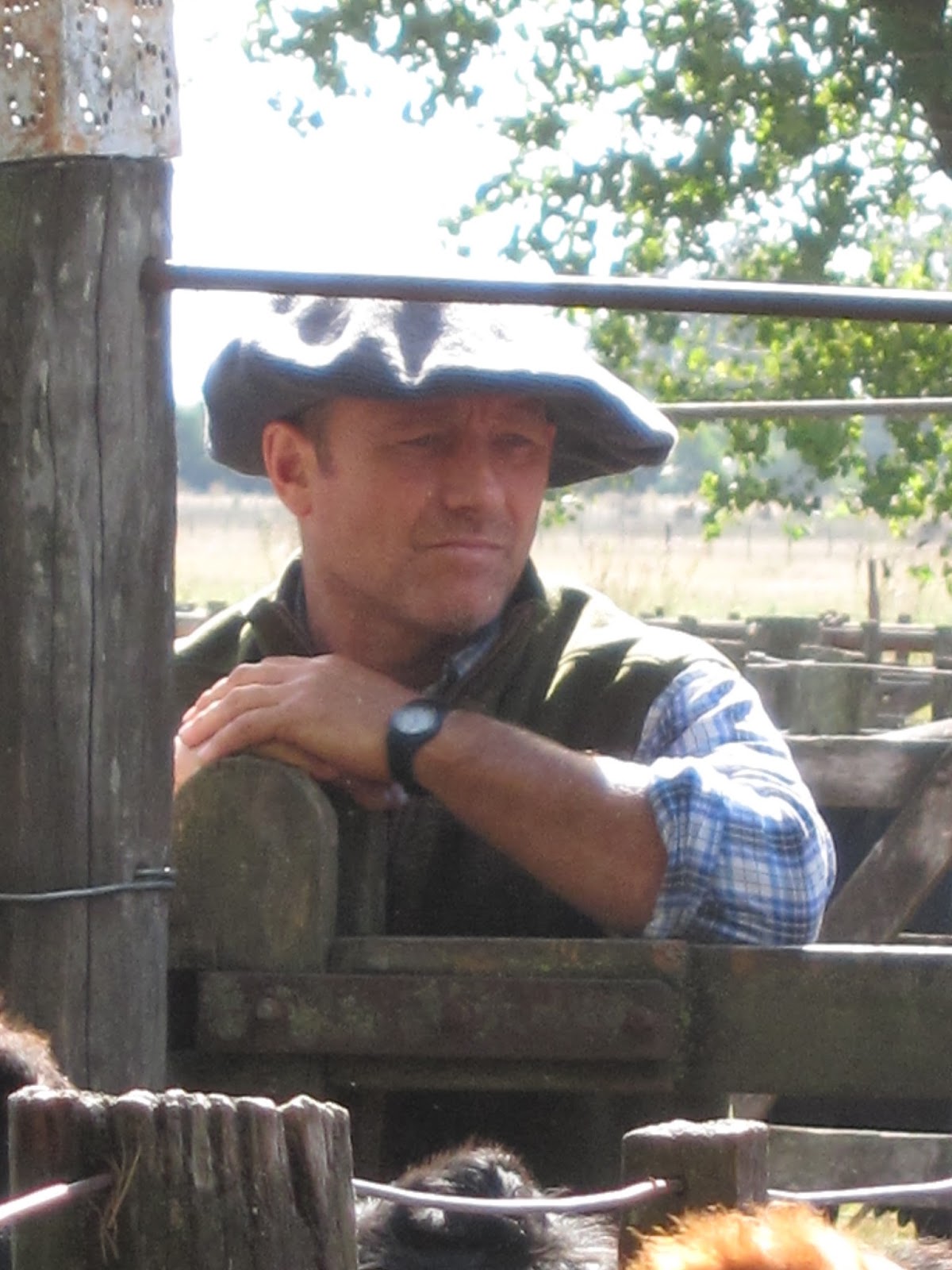
I kept looking at this guy and his younger friend at the Cattle selling/stockyard. Blue eyed, Basque perhaps but clearly a representative of the diverse European backgrounds of the immigrant populations.
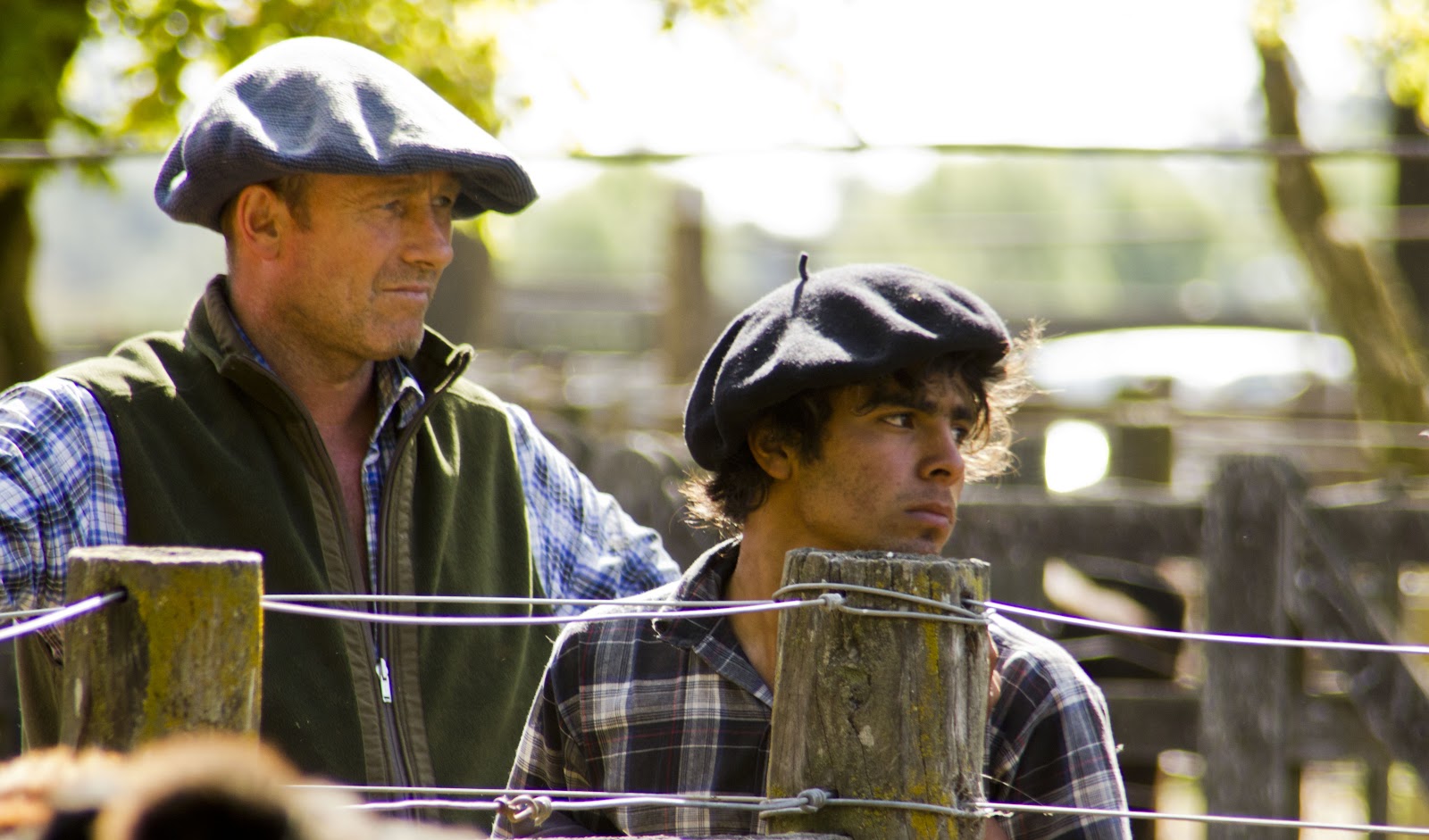
My host who invited me along.Following an hours drive to Ayacucho where we dined (lunch) lavishly with a group of cattle breeders, we proceeded to the stockyards and the awaiting cattle whose fate would be sealed as the highest bidder settled the issue.
My host is cobbling together different interests, he's following his father in the buying and selling of cattle right now. I asked him what his long terms goals were and he looked at me as if I was from Mars. "Long term goals?" We work a variety of jobs and go with what seems to offer the best opportunity". Career goals? He just laughed.


 This is immigrant populations with lots of Welsh, Italian,Basque,Slovak and other groups.  Towns like this exist in the rural periphery of Buenos Aires. I should say we're 3 hours away and definitely rural and not relating to Buenos Aires other than all traffic and commerce heads that way. Can't deny it.
The horse drawn carriage with the barker identifying different groups of cattle for sale. All done with a nod, a wink, a raised eyebrow.


 I went to one town for a cattle sale. It just happened to be  full of Basque descendants. They know family lines and history and who is related to whom whether you are from there or not. People are open and friendly and enquire about my trip. They invite me to dinner. They have long lost relatives who left Europe in 1900 and went to America. They feel a connection. We're all immigrants. Families went in different directions. Some went to North America and some to South America. Where else can you still find the largest Jewish community in the Diaspora but Buenos Aires?
Azul was built in 1832 at the direction of Governor Juan Manuel de Rosas as an outpost or fort, on the fringe 'of civilization' where the government attempted to control more and more land that previously was inhabited by wandering indian groups. Argentina did an even better job or subjugating the indigenous populations than we did in the USA.. Hardly any exist today. They 'honor' the indigenous populations by naming streets after them. Sound firmiliar?
Now it is all agriculture and cattle and the people are doing quite well by all standards.Some pictures of cattle stock yards will attest to the continuing investment in cattle, the struggle around planting Soybeans and the ongoing balance of a faltering economy.


Wait a minute. I'm getting way ahead of myself. From Ushuaia in Tierra del Fuego up to here is about 3000 kms. All that distance is Pampa, wide open rock strewn territory that is governed in some areas by rabbits, foxes, and sheep and oh yes, oil. Some motorcyclists say it is a boring trip up the coast toward Buenos Aires. Used to rocky,crushed gravel roads which can be difficult in the best of conditions in the south, now it is paved, it is long, it is straight, it is still plagued by strong cross wind which add to the challenge or threat, however you frame it. The coastal dry sand dunes main attraction is the sealife, ranging, depending on the season,to Sea Lions, Penguins, and even touch calving whales, breeding grounds that allow close contact. That is the coast. As we move further north after several days of travel the landscape changes and what was once open rock strewn landscape becomes a little hillier, a little greener, some diversity is noted. Streams flow, grass grows, livestock is seen along the road munching away. All of a sudden you are in a different environment. The same, yes but different. Richer, visually and it excites you as you enter another zone.
I'm heading in this direction because there is a supposed 'outpost' of motorcycle enthusiasts who either live here or gather here and I want to find out what they are about.They live in Azul (Blue)
I'm also here, ahead of schedule, because I bought my 'cuchillos criollos, gaucho knives, hand made steel with traditional handles of deer horn and armadillo tails,etc.in another town close by and here I am.
The motorcycle group consists of perhaps 10-15 middle aged men with motorcycles who like to either talk about a trip they plan or a trip they made. Sound familar? All of this is equally spiced by long winded discourses on politics,etc. of which the Argentines cannot be outdone. Where else can a group of men spend a long evening talking tell 2 AM around a fire with beef and wine? I did this 3 times in a week. The only difference is that I didn't have to get up and go to work the next day. That didn't seem to stop them from connection which is VERY,VERY big here.They are affectionate, touch each other when talking, kiss on the cheek when meeting. Something missing in my life.
So here are some photos of the meals that a group of men put together and the 'clubhouse' filled with momentos and signs of world motorcycle travelers over they years who have passed this way coming or going to Buenos Aires ( 3 hours and a world away).


 my camping spot on Peninsula Valdez. The next site was this lovely 130 year old mansion in Azul. Built by a Brit with lots of money, it has many, many rooms, a huge pool and an assortment of cattle, horses, llamas and other critters on 120 acres. Small by comparison.


 Chacras de Azcona. My "digs"for 5 days longer than I intended to stay. Why do I have to put up with these meager dwellings???


An early 60's Citroen deux chevier still working and used daily.

The main house at Chacras de Azcona in Azul.

AZUL, Provincia de Buenos Aires- The Motorcycle Gang

I originally headed for Azul, a 'small town' of 60,000 some three hours outside the fringe of Buenos Aires to visit an 'outpost' 'la posta' de motoqueros, a small self supporting excuse to gather and tell stories, eat, drink and make friends. That I did. I was welcomed by Jorge, "El Pollo", his nickname meaning chicken, why, I have no idea except nicknames are common and used among friends. It is in his two car converted garage that this club house gathers. The walls are covered with writings, pictures, mementos from world wide motorcyclists who have stopped here over the years. It is a comfortable place especially when the parrilla fire is going and steaks and other meats are cooking away and the fresh bread, wine and salads cover the table. The place starts getting crowded. I'm the guest and everyone wants to hear stories and tell their own from years of motorcycle travels in Argentina and Chile. Here are some photos. I participated in three asados in one week. I wondered what their wives thought?
A German Couple (right side)each on BMW motorcycles. They've been on the road for several years. They settle when funds run low, work then continue on their way

up on the rafters go a momento of their visit


 joining us was a couple from Romania on their motorcycle.

 much political discussion takes place. All of these guys live and work in Azul, mostly in agricultural pursuits.

What a fabulous meal awaits us!

THE CHANGING FACE OF WEATHER- PATAGONIA


The Changing Face of Weather- February 2013- Patagonia

The lament of farmers everywhere, not just here, is how the climate seems to be changing. It was a common theme in conversations across the expansive Pampas of Patagonia. Lakes are drying up, sandstorms whip across the broad expanse of land, springs that once fed pasture are reduced in volume.
Four seasons can happen in a day and frequently do. Further south in Tierra del Fuego where the unceasing wind howls, people are complaining of not enough sun and summer fun has been curtailed. In an area already starved for warm weather it is bleak to imagine such a shortened season. It is still beautiful but too reminiscent of the Pacific northwest with gray skies and, well, you know the rest.
 

I am currently on Peninsula Valdez,(google map it)(very much south of Buenos Aires on the Atlantic)  that narrow isthmus of land that juts out into the southern Atlantic Ocean. The narrow spit bursts into a bubble of land that is a tourist destination for anyone interested in seeing Whales up close, Orcas that have developed ways of beaching themselves to gobble up unsuspecting baby seals. Sea Lions, Penguins and a host of land based animals like the Ostrich, Guanaco (llama like in appearance), armadillos, fox and hare. Sheep are also found here.                                                  

                                            Notice the strong and broad winds whipping up across a now dry lakebed.


Windswept barren landscape that is a World Heritage site, the ‘bubble of land’ has an almost enclosed golfo San Jose probably 40 kms across yet only open by 1 km. and several large depression salt flats in the middle of the Peninsula that are 100 feet below sea level. The Peninsula is cris- crossed by several gravel roads that lead to the predominate calving grounds of whales, sea lions and penguins.
A sign on a scraggly tree indicating that one day it will give shade if there is enough water to nurture it.

The Atlantic coast of Argentina. It is dry, predominately sand and uninteresting.

Sunday, February 17, 2013

SHEEP AND THE ESTANCIA-driving 500 sheep


SHEEP AT THE ESTANCIA “LOS PINOS” Feb. 2013

My friend Gerardo and I traveled to la Estancia (farm) of Carlos Abait to buy 500 sheep and bring them back to Gerardo’s Estancia.  Aniceto CayuƱanco,  the peon that lives at Gerardo’s farm rode two days with his 2 sheepdogs to get to Carlos’ farm. It would be his job to bring 500 sheep back to Gerardo’s alone. This is rugged country, very rocky with mountains, valleys and broad flat plains the predominate features. He knows this country. He was born ‘up the road in a village of 40 people. His nickname is ‘choique mora’meaning ‘black ostrich’, a common bird found around here. A Mapuche-T Indian who has worked his whole life on sheep farms, he thought nothing of the task. He took an extra horse to carry his few positions, his one working sheep dog and set out. He would have to move the sheep according to the weather and would bivoc where he could locate shelter from the rain and strong winds and let the tired sheep settle for the night. It was a 60 km drive from one Estancia to the other. It would take him 3 days to get the sheep from one place to the other.
When we arrived at Carlos’ Estancia we were warmly greeted since few visitors ever come by. He was expecting us.
With no phones or electricity communication is done by radio. Radio, the old way. People living in very rural areas send messages to the radio station in town (150 plus kms. away in this case) where they are broadcast to others who sit by their radios in the morning or at night listening for news. A typical message might be “ Juan and Maria are coming to visit Gerardo Viviers at the Estancia Los Sauces on Tuesday next” or “Juana had a baby boy in Sarmiento last Friday and will be returning to Estancia Los Sauces next Monday’. Most all messages originate in towns rather than Estancias unless the Estancia has power and some communications. Cell phones don’t work out here and fixed line phones don’t exist.
Carlos’ farm is 23,000 hectares (2.2 acres per hectar)(over 50,000 acres of land) and he has 8-9,000 sheep roaming the rocky landscape. He looses about 10% per year, mostly to foxes and mountain lions. This is an ongoing issue and involves hunting and poisoning to try and limit the wanton destruction of the sheep. A mountain lion will kill and partially eat a sheep but kill 50 more as that is its nature. The same behavior goes for foxes.
Fox skins can bring 150 pesos or(about $25.00) as they are sold. The other animal found in this area is the Liebre (rabbit). When the population of rabbits is high, the mountain lion and fox hunt them, when low, they go for sheep. I am told that a company was out shooting as many rabbits as they could and the meat and pelts were being shipped to Germany. The unforeseen consequence of this business was to greatly reduce a favored food source for predators and increase sheep loss since fox and lion will hunt and kill what is available.
Gerardo is paying $100.00 (U.S.) per sheep. They are 2 to 4 years of age and will live about 8 years. Gerardo figures that if he can increase his own sheep population to 2000, he’ll get 10,000 kilos of wool each year from the sheep. He’ll get $3.50 per kilo (depending on quality) which gives him $35,000.00 a year. He’ll also get another $10,000.00 for meat sales. This is before costs.
Aniceto, the peon who drove the 500 sheep for three days from one Estancia to another.

Part of the process of marking the sheep for age, gender,and where they go next. 2,000 sheep passed through this process before their bath and injections.

bringing in the sheep from higher pastures to the corral for marking.

 Don Carlos looks on as sheep are marked.

 Aniceto takes a moments rest between marking.

 Giving the sheep their medicine.

 On day three of the movement of sheep from one Estancia to another.

Tightly packing the sheep allows them little room to move about.

 Carlos' head peon, adjusts the medicine.

Blustery sunset over the Estancia "Los Sauces".
The Sky with strong winds a constant feature. Moving across the southern Pacific and over the Andes drops and creates incredible formations.

 Aniceto on the drive.The threat of rain has diminished and now the fear is high heat. If that happens the tired sheep will just stop creating problems of no water for them for miles.

 The sheep finally arrive at 'greener pastures after three days of walking.

My friend Gerardo. We studied together in graduate school in Bs.As.,Argentina some 40 plus years ago.

Gerardo’s  peon, Aniceto gets $10,000 pesos Argentinos a month (currently about 5 pesos to the U.S. dollar.) Of that 10,000, medical insurance, retirement,etc. takes a big chunk leaving Aniceto with about $4,300 Argentine pesos a month as ‘take home pay’. That means he gets a little over $200.00 (U.S.) a month to live on. Not much. Minimum wage in Argentina is $2,800 pesos a month (U.S. $140.00).

Monday, February 4, 2013

A DAY ON THE ESTANCIA HERBERTON, TIERRA DEL FUEGOA DAY ON THE FARM-the Estancia in Patagonia/ Tierra del Fuego Feb. 2013 After having reached ‘the end of the road’ I had an opportunity to visit one of the most notable Estancias in Patagonia/ Tierra del Fuego. The expansive sky mirrors the expansive territory that this Estancia encompasses. Nothing is small down here, everything is big and the distances are hard to comprehend. Take for example this Estancia. I can’t get my head around an Estancia that encompasses as far as the eye can see- from the distant mountains to all the islands in the Beagle Channel. We’re talking about 250,000 hectarias (500,000 plus acres). The story of Harberton, the name of this Estancia, begins with Thomas Bridges an abandoned baby found under a bridge in Bristol, England about 1845. He had embroidered on his clothes a “T” therefore Thomas Bridges. He was adopted by an Anglican minister and in a short time (1856) he moved with his family to the Malvinas Islands (Falklands) . Within 3 years some missionaries were sent from the Malvinas to the area around Ushuaia and were all killed during the first religious ceremony they had but the local inhabitants called Yamanas. In 1859 he set out as a very young man and landed in Ushuaia. Soon thereafter he established the Estancia. Since he had grown up speaking the ´Yamana language he was the first white man to live and establish residency in Patagonia. He was accepted by the locals. One of his most outstanding legacies was to create a ´Yamana dictionary of 35,000 words. This work still stands as the only definitive and authorative source for information on this language. He was the first to introduce sheep in the area and also the vaccination of cows. Further information can be found in the wonderful book called “The Uttermost part of the Earth”. I read that book some 25 years ago and so, being in the area, I had to visit and see the Estancia. A number of interesting items can be found on the Estancia including whale bones, animal skins, sheep shearing equipment and of course the introduction of ‘modern technology’ from England in the late 1800’s. For example, the main houses were the first pre-fabricated houses in the Patagonia and beyond. The houses were built in England and each piece was numbered, the house dismantled and shipped to the Estancia where it was re-built. Local indigenous people who had been taught carpentry helped with the construction. They now wore clothing (previously, as noted by Darwin, the indigenous people wore no clothing, only wrapped in Guanaco skins and living a migratory life style hunting and fishing.) (Darwin called the people savages and cannibals. Bridges set out to change the world’s opinion by showing a different side of the culture). Here are some photos of the Estancia as it currently exists.


A DAY ON THE FARM-the Estancia in Patagonia/ Tierra del Fuego   Feb. 2013

After having reached ‘the end of the road’ I had an opportunity to visit one of the most notable Estancias in Patagonia/ Tierra del Fuego. The expansive sky mirrors the expansive territory that this Estancia encompasses. Nothing is small down here, everything is big and the distances are hard to comprehend. Take for example this Estancia. I can’t get my head around an Estancia that encompasses as far as the eye can see- from the distant mountains to all the islands in the Beagle Channel. We’re talking about 250,000 hectarias (500,000 plus acres).
The story of Harberton, the name of this Estancia, begins with Thomas Bridges an abandoned baby found under a bridge in Bristol, England about 1845. He had embroidered on his clothes a “T” therefore Thomas Bridges. He was adopted by an Anglican minister and in a short time (1856) he moved with his family to the Malvinas Islands (Falklands) . Within 3 years some missionaries were sent from the Malvinas to the area around Ushuaia and were all killed during the first religious ceremony they had but the local inhabitants called Yamanas.
In 1859 he set out as a very young man and landed in Ushuaia. Soon thereafter he established the Estancia. Since he had grown up speaking the ´Yamana language he was the first white man to live and establish residency in Patagonia. He was accepted by the locals.
 One of his most outstanding legacies was to create a ´Yamana dictionary of 35,000 words. This work still stands as the only definitive and authorative source for information on this language.
He was the first to introduce sheep in the area and also the vaccination of cows. Further information can be found in the wonderful book called “The Uttermost part of the Earth”. I read that book some 25 years ago and so, being in the area, I had to visit and see the Estancia.
A number of interesting items can be found on the Estancia including whale bones, animal skins, sheep shearing equipment and of course the introduction of ‘modern technology’ from England in the late 1800’s. For example, the main houses were the first pre-fabricated houses in the Patagonia and beyond. The houses were built in England and each piece was numbered, the house dismantled and shipped to the Estancia where it was re-built. Local indigenous people who had been taught carpentry helped with the construction. They now wore clothing (previously, as noted by Darwin, the indigenous people wore no clothing, only wrapped in Guanaco skins and living a migratory life style hunting and fishing.) (Darwin called the people savages and cannibals. Bridges set out to change the world’s opinion by showing a different side of the culture).
Here are some photos of the Estancia as it currently exists.
The garden with seasonal flowers, strawberries, lettuce and other veggies you'd find in a northwest garden in summer.

The pre-fab house built in England, taken apart and shipped with numbered pieces. Pretty good for the 1870's.
A boat built by one of the sons and a Condor with a 9' wingspan in the barn at the farm.

A view up the hill.Many outbuildings for a flourishing farm of yesteryear.

Wood is the prime source for heating. You can never have enough though it is very plentiful . This pile was about 12' high.

A view looking down on the harbor. Although there is a road (85 kms.of dusty road) it is sometimes easier to avoid the mountain pass (had snow on it last week) by taking the launch through the Beagle Straits to Ushuaia.


The walk way between the main house and the barn and other storage buildings.


you never know what you'll find down south.


The wind shapes the landscape.